
Abstract
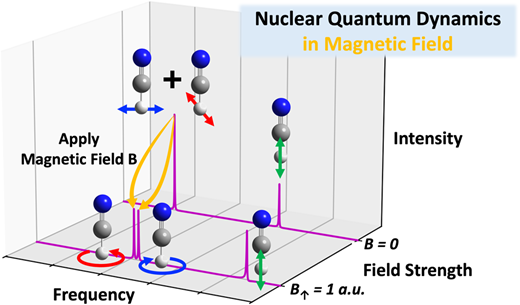
Harnessing a static magnetic field to drive molecular vibrations presents a promising avenue for controlling chemical processes. However, the coupling of nuclear dynamics with an external magnetic field has largely been explored only through classical approximations. In this work, we introduce a time-dependent quantum dynamics formalism based on London nuclear–electronic orbitals, enabling the simulation of magnetic field-driven quantum dynamics. Through simulations of HCN and H₂CO molecules, we provide a detailed analysis of how the relative orientation of the magnetic field and vibrational symmetry influence the resulting quantum dynamics. Our findings reveal field-induced mode couplings and symmetry-dependent effects, offering new insights into the role of magnetic fields in vibrational control.